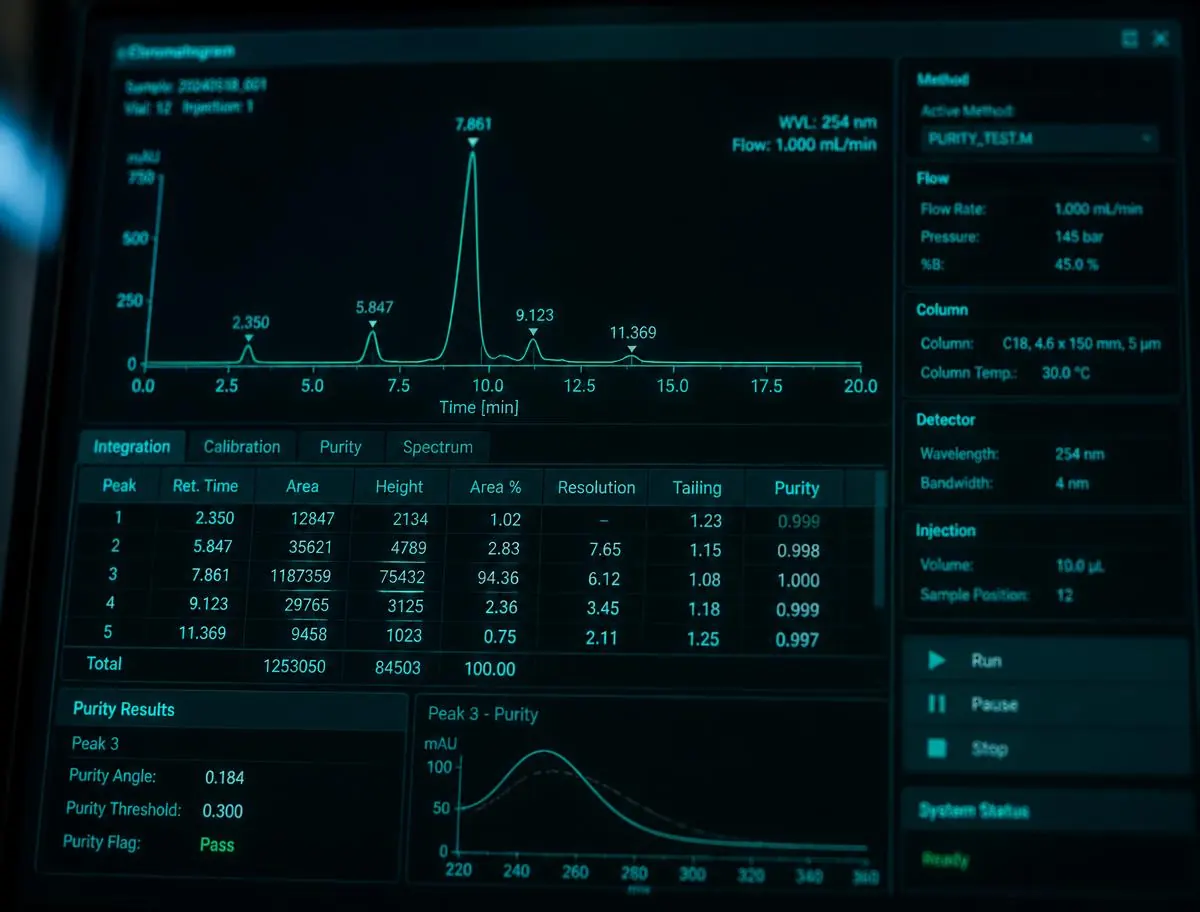
Peak area percentage is only half the story. Here is how our QC team evaluates shoulder peaks, gradient choice, detection wavelength and integration limits before signing off on a purity number.
Read the full entry: Reading an HPLC chromatogram without fooling yourself
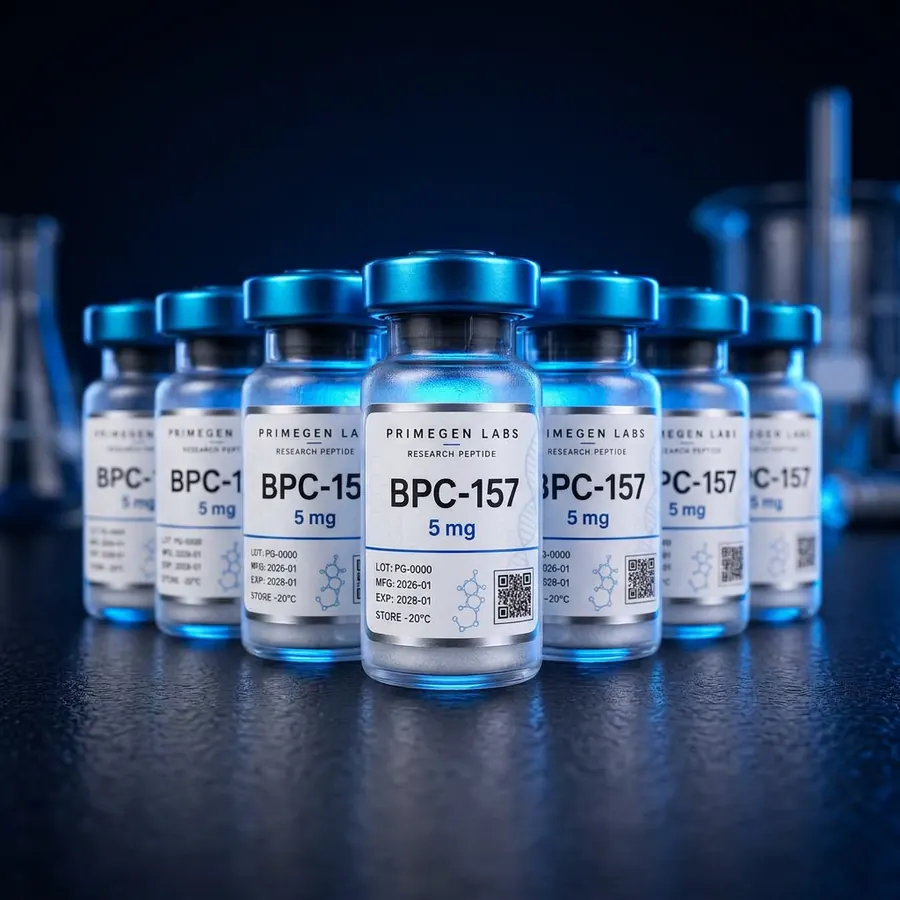
Residual oxygen is the quiet cause of oxidation in methionine and tryptophan containing sequences. A look at freeze drying, stoppering under nitrogen, and what the gas above the cake is actually doing.
Read the full entry: Lyophilization under nitrogen: why headspace matters
This is where we publish practical material for people handling research peptides day to day: how analytical documentation should be read, why storage and reconstitution decisions change measured potency, what changes between a parent peptide and its modified analogue, and how supply chain choices affect reproducibility. It is written for laboratory staff and research buyers, not for consumers, and nothing published here is clinical guidance.
Longer technical explainers live in the research library, which is organised as reference material rather than as dated posts. If there is a topic you would find useful — a walkthrough of a particular assay, a comparison of storage strategies, a breakdown of how counter-ion content affects molar calculations — laboratory support forwards requests to whoever is writing.
What we publish, and what we deliberately do not
The library is written for people handling research peptides at the bench: how to read an analytical report, how to store and reconstitute lyophilized material, how diluent choice affects a working solution, how to compare suppliers on documentation, and how the analytical methods behind a certificate actually work. The intent is to make the material we sell easier to use correctly, not to argue that any particular sequence should be used at all.
For that reason there is no dosing content anywhere in the library, no protocol aimed at human or veterinary administration, no comparison of compounds by supposed clinical benefit, and no testimonial content. Research peptides sold here are laboratory chemicals with no approval for administration to people or animals, and publishing anything that reads as usage guidance would be both misleading and irresponsible regardless of how it was framed.
Articles are revised as our own practice changes rather than published and abandoned. Where a guide describes a procedure — aliquoting, desiccation, converting a fill weight into a molar concentration — it reflects what we do in the facility, and where a claim depends on the specific analytical method used, the method is named so a reader can judge whether it transfers to their own setup.