Logistics

Ambient transit and the stability of lyophilized peptides

8 min read Last updated January 19, 2026By PrimeGen Research TeamBeginner

Transit time modelling, ambient stability windows, and what actually happens to a sealed vial that sits on a loading dock for six hours in July.

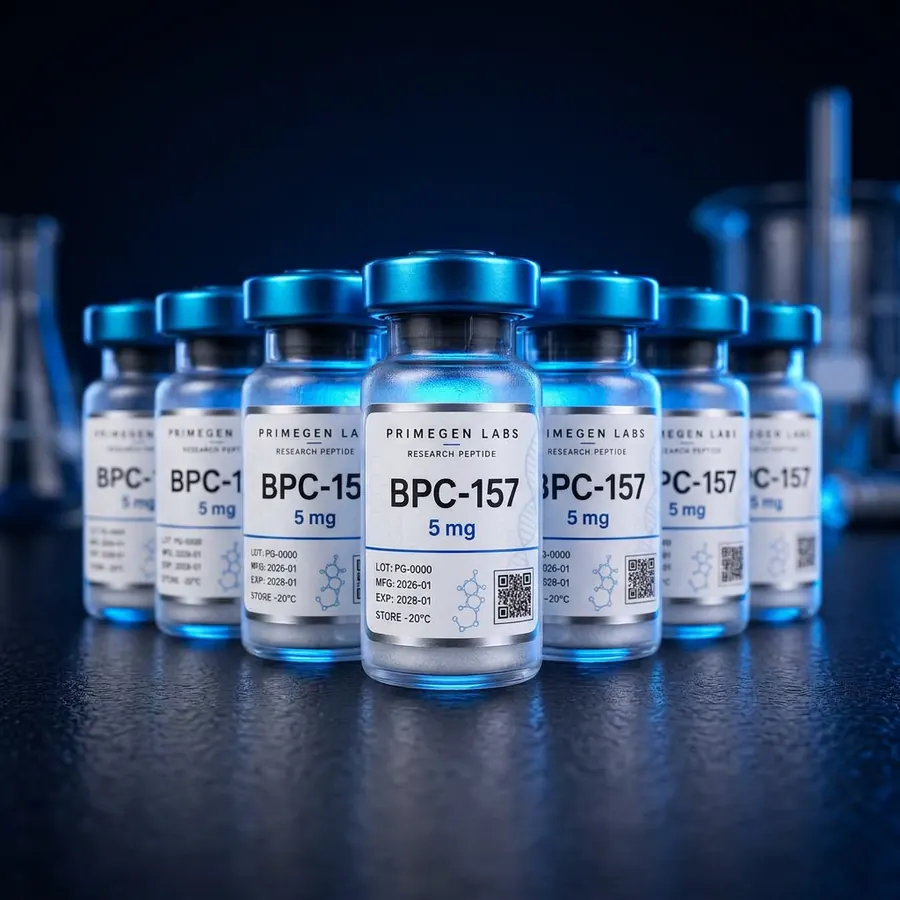
Sealed PRIMEGEN LABS vial of lyophilized peptide powder with aluminium crimp cap

In summary

Transit time modelling, ambient stability windows, and what actually happens to a sealed vial that sits on a loading dock for six hours in July. This journal entry is published by PrimeGen Co., a United States supplier of lyophilized research peptides, and covers storage and stability for laboratory research contexts only.

Topic:
Storage and stability
Reading time:
8 min read
Sections:
Solid-state stability is a different problem · Arrhenius arithmetic and short excursions · Why we do not ship cold chain · What packaging actually protects against · Receiving and first handling · What we verify, and what we publish
Published:
July 15, 2025
Last updated:
January 19, 2026
Scope:
Laboratory research use only — not medical guidance

Key takeaways

  • Lyophilized peptides are kinetically stable at ambient temperature for weeks; refrigeration is a long-term storage measure, not a transit requirement.
  • Degradation follows Arrhenius behaviour, so a short warm excursion contributes far less than continuous warm storage.
  • The seal and the dryness of the cake matter more during transit than the ambient temperature does.
  • Cold packs that thaw mid-transit can create condensation risk, which is why we do not ship cold chain.
  • On arrival, vials should be brought to room temperature before opening to avoid drawing moisture into the cake.

Solid-state stability is a different problem

Most stability intuition comes from solutions, where degradation is fast, temperature-sensitive and continuous. A lyophilized cake behaves differently. With water removed and molecular mobility drastically reduced, the reactions that dominate in solution slow by orders of magnitude.

Published stability work on lyophilized peptides consistently shows that dry, sealed material tolerates ambient temperature for extended periods with minimal measurable change. Manufacturers of clinical peptide products routinely specify room temperature storage for the lyophilized form and refrigeration only after reconstitution, which reflects the same underlying chemistry.

This is the central point for anyone worried about a package sitting in a warm vehicle: the material in transit is not the material in a vial of solution. The relevant question is not whether it got warm, but how warm, for how long, and whether the seal held.

Arrhenius arithmetic and short excursions

Chemical degradation rates rise roughly exponentially with temperature, described by the Arrhenius relationship. A widely used approximation for peptide degradation is that the rate doubles for every ten degrees Celsius of increase. That approximation is what makes short excursions tolerable.

Consider a vial that spends six hours at 35°C instead of 22°C. That is a rise of roughly thirteen degrees, so the instantaneous rate is between two and three times higher. But it applies for six hours out of a storage life measured in months. The total additional degradation is equivalent to perhaps fifteen to eighteen extra hours at room temperature — a rounding error against a multi-month shelf life.

The same arithmetic explains why continuous warm storage is a genuine problem. Six hours at 35°C is negligible; six months at 35°C is not. The variable that matters is the integral of temperature over time, not the peak reading.

Why we do not ship cold chain

Cold chain shipping sounds like a strict improvement, and for solutions and biologics it usually is. For a sealed lyophilized vial it introduces risks that outweigh a benefit the chemistry does not require.

A gel pack cools the package for a period and then thaws. Once it thaws, the package interior is warm, humid and no longer insulated in any useful way. If the vial cycles below the dew point and back, condensation can form on the exterior glass and, if the seal is anything less than perfect, moisture can be drawn toward the cake as the interior pressure changes.

Add unpredictable carrier delays, and a package intended to arrive cold can spend two days in a wet, warm insulated box — measurably worse than the same vial shipped dry at ambient. Our decision to ship ambient is a stability decision, not a cost decision, and it matches how lyophilized peptide products are handled commercially.

What packaging actually protects against

The real transit hazards for a sealed vial are mechanical and hygroscopic, not thermal. A dropped carton can crack glass or unseat a stopper. A crushed box can deform a crimp. A package left in rain can wet a carton and, over hours, raise humidity around the closure.

Rigid outer packaging, individual vial retention so glass does not contact glass, and moisture-resistant inner wrapping address all three. These measures cost less than cold chain and target hazards that actually occur in ground transit.

We also keep transit windows short and domestic. Every order ships from the United States, which removes customs holds — the single largest source of unpredictable multi-week delays and the situation in which ambient assumptions genuinely start to strain.

Receiving and first handling

When a package arrives, the first step is inspection rather than immediate opening. Check the carton for crushing or water damage, then check each vial for intact glass, a seated stopper, a firm crimp that does not spin, and a cake that still looks like a cake.

If the package has been in a cold vehicle in winter, let the vials equilibrate to room temperature before breaking the seal. Piercing a cold stopper in a warm humid room allows moist air to enter and condense against chilled glass, which is one of the few genuinely avoidable ways to introduce water into a dry cake.

For long-term storage, refrigeration or freezing of the sealed lyophilized vial is appropriate and will extend usable life well beyond ambient storage. That is a storage recommendation for material that will sit for months, not a statement that the transit condition was inadequate.

What we verify, and what we publish

Every lot is analysed before release, and the underlying third-party documentation is published rather than summarised. That documentation establishes the condition of the material at the point it entered inventory.

Transit performance is monitored through what arrives back to us: seal integrity issues, cake appearance complaints and reconstitution reports. Across domestic ground transit the failure mode we see is mechanical, not thermal, which is consistent with everything the solid-state stability literature predicts.

Anyone who wants to verify a specific vial has the same tools we do — the lot number on the label maps to a published certificate, and the certificate carries the analytical method, not just the result.

Frequently asked questions

Does my package need to arrive cold?
No. Sealed lyophilized peptides are stable at ambient temperature for the duration of domestic ground transit. Refrigeration is a long-term storage measure for material that will be held for months, not a transit requirement.
My package sat in a hot vehicle for a day. Is it ruined?
Almost certainly not. Degradation rate rises with temperature, but a short warm excursion contributes only a small fraction of a multi-month shelf life. Inspect the vials for an intact seal and an intact cake; if both look normal, the material is normal.
Should I refrigerate vials as soon as they arrive?
For material that will be used within a few weeks, ambient storage away from light and humidity is sufficient. For longer holding, refrigerating or freezing the sealed vial extends usable life. Always allow a chilled vial to reach room temperature before opening.
Why does the certificate of analysis not cover transit?
A certificate documents the analysed condition of a lot at release. Transit condition is managed through packaging and routing rather than testing, because opening a vial to test it destroys the seal that protects it. The two controls are complementary.

Related research compounds

Compounds discussed in this entry, each with its own monograph, specification table and published certificate of analysis.

About the author

PrimeGen Research Team

Analytical & technical writing, PrimeGen Co.

Our library is written in-house by the same team that reviews incoming lot analytics, reads third-party certificates of analysis and maintains compound documentation. Articles are educational reference material for laboratory professionals and describe published in vitro and preclinical literature only.

Published July 15, 2025 · Last reviewed January 19, 2026

References and further reading

  1. Stability testing of new drug substances and products (Q1A)ICH harmonised guideline
  2. Solid-state stability of lyophilized peptidesJournal of Pharmaceutical Sciences
  3. Peer-reviewed literature index for peptide stabilityPubMed, U.S. National Library of Medicine